
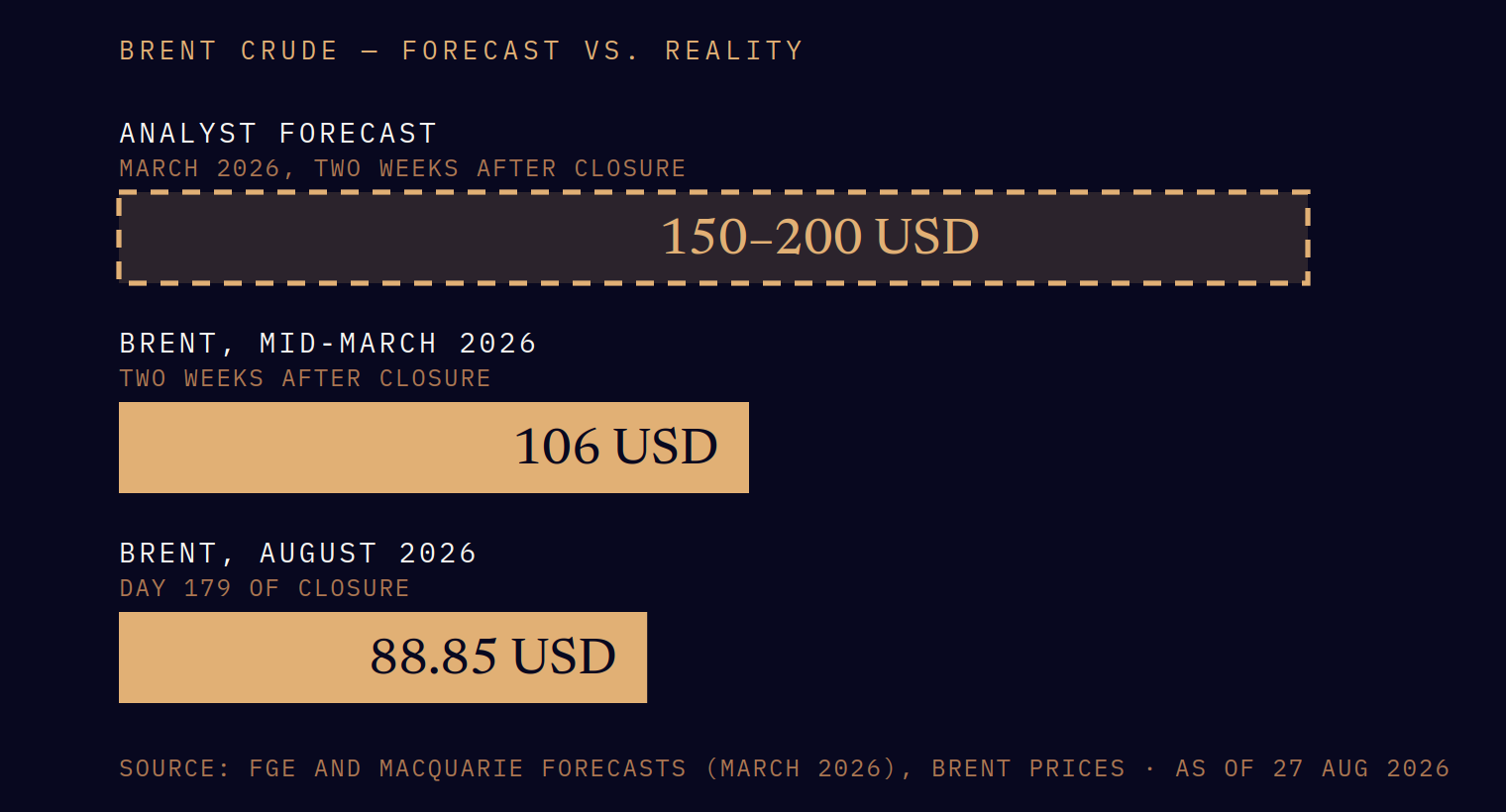
In mid-March 2026, the Strait of Hormuz had been shut for two weeks and Brent traded above $106. FGE was talking about a $150–200 range. Macquarie put the odds of $200 oil at roughly one in five.
It is now 27 August. The strait has been closed since 28 February — a hundred and seventy-nine days. Traffic is down ninety-five percent. Brent is at $88.85, which is less than it cost when the closure was two weeks old.
The scenario did not fail to materialise. It materialised, and in a worse form than anyone forecast. What failed was the assumption about what the price was actually tracking.
What actually happened
Iran closed the strait to routine commercial traffic on 28 February. In normal conditions roughly twenty to twenty-one million barrels a day move through it — about a fifth of global petroleum liquids consumption.
The market’s first reaction was textbook. War-risk premiums on tankers went from around 0.05 percent of cargo value to over five percent. That hundredfold jump was enough on its own to price most commercial traffic out of the strait, without a single additional shot being fired.
Then came a ceasefire in early April and, in mid-June, a memorandum between the United States and Iran. The strait reopened around 17 June and ship-tracking data showed traffic surging. On 26 June, Brent closed below where it had been before the conflict began.
The agreement collapsed in early July after attacks on commercial vessels. By the end of July the strait was effectively shut again, and it has stayed that way. IMF PortWatch recorded three transits on 23 August. The pre-crisis baseline is around eighty-five a day.
A hundred and seventy-nine days. Three ships a day instead of eighty-five. And oil cheaper than it was in March.
The forecasts were not wrong by a margin — they were wrong about the mechanism
The error was not in estimating how far the price would spike. It was in assuming the price would stay elevated for as long as the cause persisted.
Oil is not priced on what has happened. It is priced on the expected balance three, six and twelve months out — and over that horizon the world adapts. Six months is a long time in energy. Routes get redrawn. Demand shifts. Inventories get drawn down and rebuilt. Production that made no sense at eighty dollars comes online. And some consumption simply disappears, because high prices make people use less.
None of that is fast. All of it is faster than a hundred and seventy-nine days.
A $150–200 forecast was implicitly a bet that adaptation would not have time to happen. That is a reasonable assumption about a two-week disruption. It is a bad one about a six-month disruption — and it gets worse the longer the disruption runs.
Which leads to the counterintuitive part: the opening weeks of a crisis are more dangerous for price than its continuation. Not because continuation is harmless, but because in those first weeks the market is pricing uncertainty about duration. Once duration stops being unknown, that uncertainty dissolves and what remains is the physical balance — which has had time to rearrange itself.
What the price is really tracking
“Strait closed” is a binary headline. Price is not binary.
When a closure hits the wires, the market assigns a distribution: how long, how complete, how quickly other producers respond, whether the conflict widens. The price is a probability-weighted average across those paths, not an answer to the question “is it shut?”
That explains the moves that look absurd if you only read headlines. The peak did not arrive on the day of closure. It arrived when permanent closure first became imaginable. When that possibility receded, the price fell even though nothing had physically improved — the opposite, in fact.
The same logic runs in reverse. If a credible report emerged today that the conflict would extend to Bab el-Mandeb and close the region’s second major export route simultaneously, the price would jump harder than it did on the original closure. Not because of the incremental volume, but because the distribution of outcomes — which has spent six months narrowing — would blow open again.
What an investor should take from this
None of this argues that geopolitics does not matter. It matters, sometimes decisively. It argues against the way geopolitics is usually reasoned about.
Three things I am taking from the past six months:
The headline describes an event; the price describes an expected duration. When I read a forecast, I look for the assumption about time embedded in it. Usually there isn’t one stated explicitly — and that absence is the error.
Adaptation is slower than the optimist thinks and faster than the panicker thinks. Six months is enough to rebuild global logistics around a chokepoint. Six weeks is not.
The dangerous moment is when the range of outcomes widens, not when the bad one arrives. For a position, that means risk rises before it shows up in the data and falls before the situation physically resolves.
What would change my mind
So that this is not merely a retrospective explanation, here are the conditions under which it stops holding:
- A sustained price rise with no change in the situation. If Brent climbs above $100 without the strait’s status deteriorating, the physical balance is tighter than I assumed and adaptation has hit a ceiling.
- Simultaneous closure of the second route. Bab el-Mandeb alongside Hormuz is a different problem from Hormuz alone — adaptation requires an alternative, and that alternative would be gone.
- Permanent loss of production capacity. So far this is a transport problem, not an extraction problem. If the wells and terminals themselves were hit, the timing logic in this piece stops applying, because rebuilding that infrastructure takes years rather than months.
None of the three has happened. Reports over the past few days of talks between Iran and Oman over a transit arrangement remain unconfirmed, and I would not treat them as a basis for anything.
The views expressed here are my own personal opinions and reflect my own portfolio decisions. This content is for informational and educational purposes only — it is not investment advice, a recommendation, or a solicitation to buy or sell any security. Always do your own research or consult a licensed financial advisor before making investment decisions.