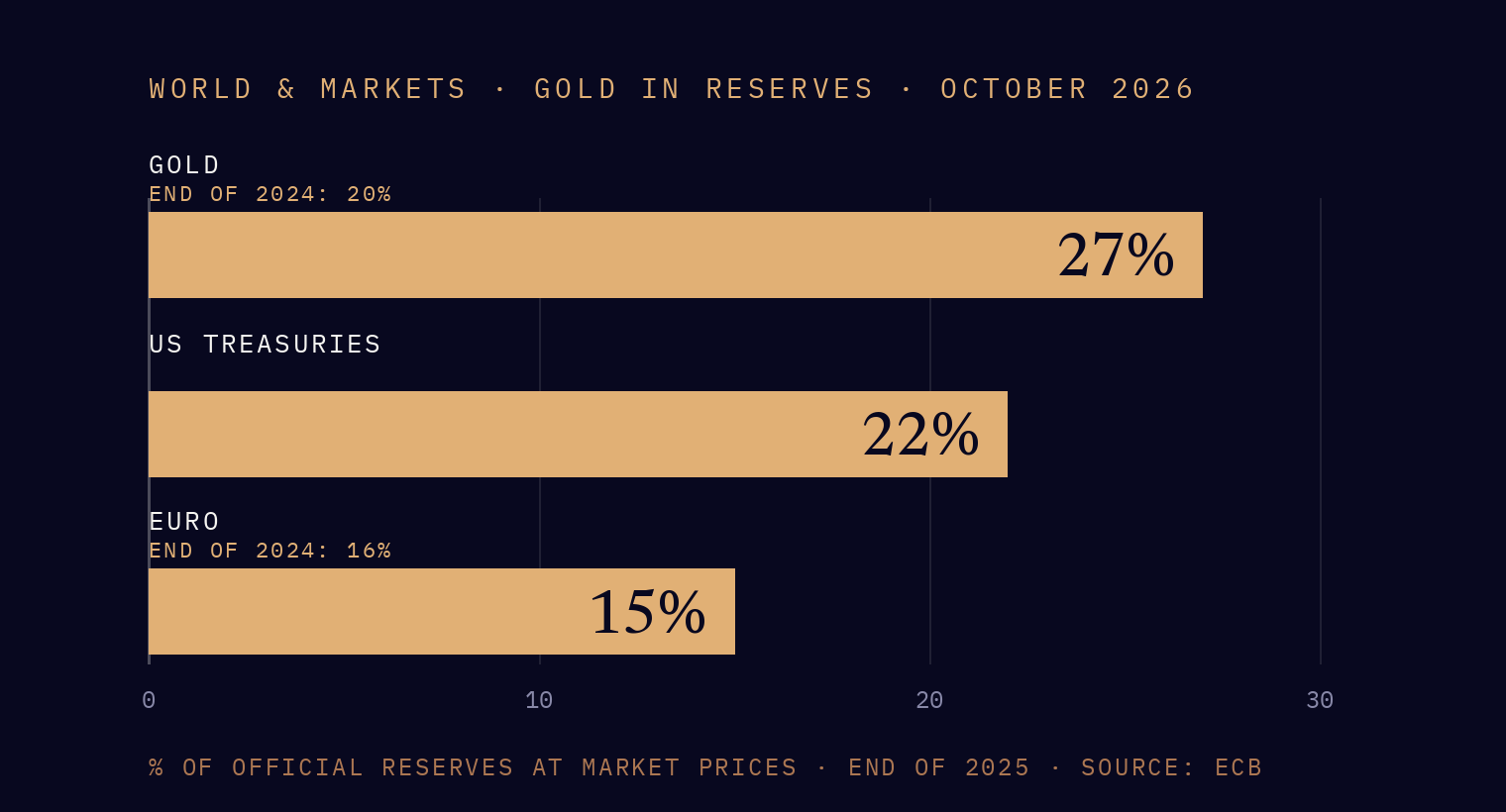
In June the European Central Bank published a number that went around the financial news. At the end of 2025, gold made up 27% of official reserves held by central banks around the world. US Treasuries were 22% and the euro 15%. So according to the ECB, gold has moved ahead of both the euro and US government bonds.
The headlines quickly turned this into a story: central banks are running from the dollar into gold. Data from the ECB, the World Gold Council (WGC) and the International Monetary Fund show something different, and more interesting for an investor.
What the ECB actually compares
First, a detail that got lost in the headlines. The ECB compares gold with US Treasuries, not with the dollar. Central banks also hold dollars in other forms, such as deposits or short-term securities. According to the IMF, the dollar still made up 57% of foreign exchange reserves in the first quarter of 2026, a measure that excludes gold. The euro had 20%.
So gold has not overtaken the dollar. It has overtaken one part of it.
Gold grew through price, not purchases
Now the main point. From 2022 to 2024, central banks bought more than a thousand tonnes of gold every year, about twice as much as in the previous decade. In 2025 purchases fell to 863 tonnes, a fifth less than the year before. Even so, gold’s share of reserves jumped from 20% to 27%.
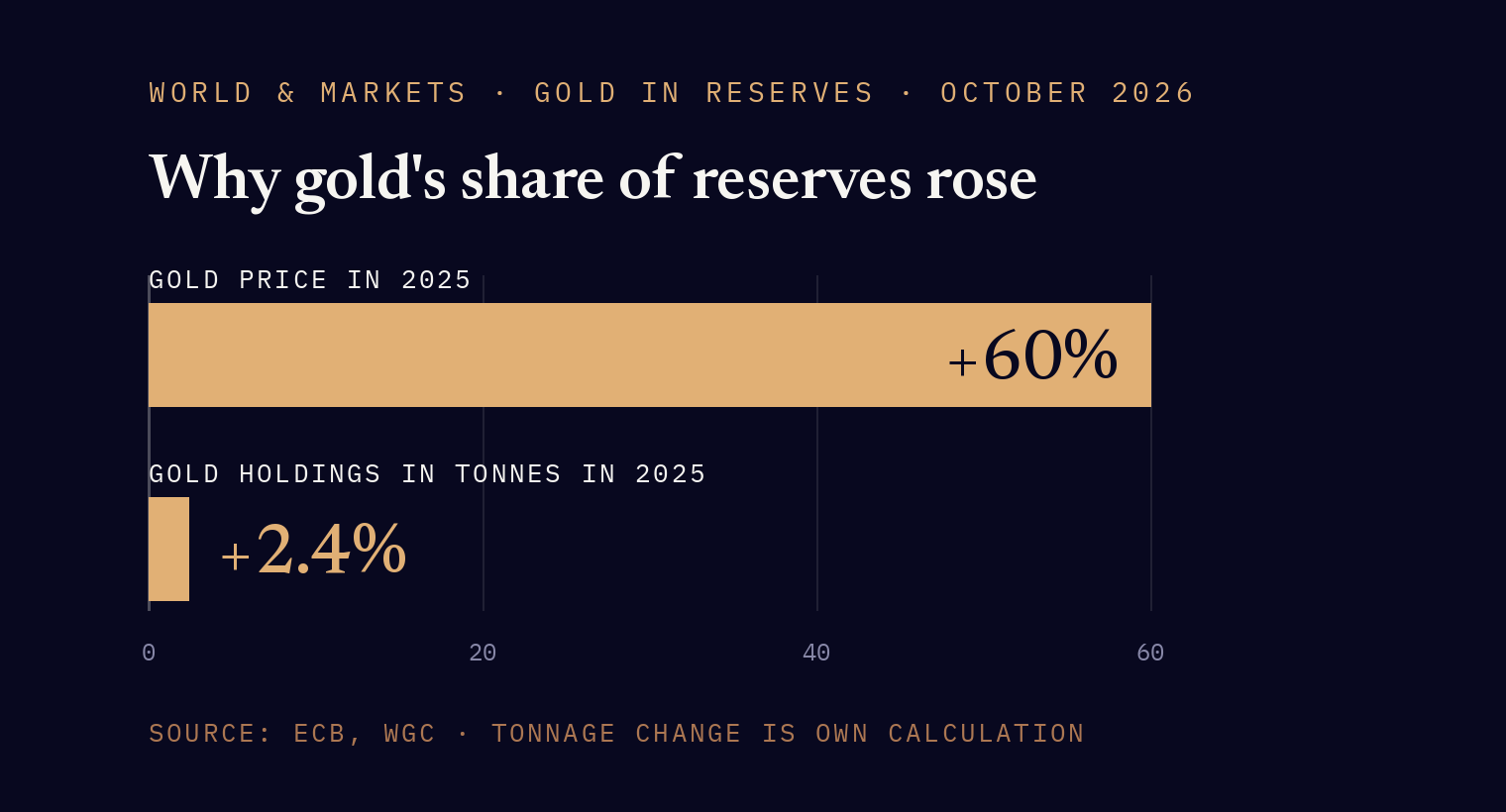
The ECB itself gives the explanation: it was mainly the price. Gold rose by around 60% in 2025 and by 30% the year before. When an asset becomes more expensive, its share of reserves grows even if nobody buys any more of it.
According to the ECB, central banks held around 36,000 tonnes of gold at the start of 2025. A full year of purchases increased that stock by only about 2.4%. The value of the stock, however, rose by roughly two thirds. If the gold price had stayed flat in 2025, gold’s share of reserves would, by my rough calculation, have fallen slightly to around 18–19% instead of rising to 27%. (My own calculation from ECB and WGC data. It is approximate, because the dollar value of other reserves also moves with exchange rates.)
For anyone reading the news, this is an important difference. “Gold has overtaken Treasuries” sounds like a decision by central banks. In reality it is largely a revaluation. And revaluation works both ways. If gold fell by a fifth, its share of reserves would drop without anyone selling a single bar.
What about sanctions?
The second popular explanation is that central banks buy gold out of fear of sanctions. After Russia’s reserves were frozen in 2022, that makes sense, and for some countries it is surely true. But an IMF survey quoted by the ECB gives a more sober picture. Two thirds of central banks said they buy gold for diversification, and two fifths for protection against geopolitical risk. At the same time, almost 90% of the banks surveyed said in mid-2024 that sanctions had not affected how they manage their reserves.
So geopolitics plays a role, but as one reason among several, not as a panic exit.
The other side: the trend is real
That is not the end of the story. The shift towards gold is real, just slower than the headlines suggest.
Central bank gold holdings are close to a record. The peak was in 1965, when the dollar was still linked to gold, at around 38,000 tonnes. Today they are only about 3% below that level. (My own calculation: 36,000 tonnes at the start of 2025 plus last year’s purchases.) The largest buyer in 2025 was the National Bank of Poland with 102 tonnes, followed by Kazakhstan and Brazil.
This year buying has picked up again. In the second quarter of 2026, central banks bought 289 tonnes according to the WGC, 62% more than a year earlier. The WGC links this partly to softer prices, which also shows that central banks do not buy regardless of price. And in the WGC’s June survey of 74 central banks, a record 45% said they plan to increase their own gold holdings over the next year. Overall, 74% expect the dollar’s share of reserves to be lower in five years.
What I take from this
In my view, the debate about gold and the dollar mixes up two different things. One is a long, slow shift: central banks are diversifying and their gold holdings are growing slowly. That is supported both by purchases in tonnes and by surveys. The other is the jump in gold’s share from 20% to 27% in a single year. That is mainly a result of the price, not of decisions.
Anyone buying gold on the argument that “central banks are running from the dollar” should therefore watch tonnes, not percentages. The WGC’s quarterly data on central bank purchases is a better indicator than any headline about reserve shares. The share mostly reflects the very price that the argument is trying to justify.
Sources: ECB, The international role of the euro (June 2025 and June 2026); World Gold Council, Gold Demand Trends for full-year 2025 and Q2 2026; World Gold Council, Central Bank Gold Reserves Survey 2026 (16 June 2026); IMF, COFER data brief (1 July 2026); LBMA gold price on 31 December 2025. My own calculations are labelled in the text. The author has no position in gold or similar assets.
The views expressed here are my own personal opinions and reflect my own portfolio decisions. This content is for informational and educational purposes only – it is not investment advice, a recommendation, or a solicitation to buy or sell any security. Always do your own research or consult a licensed financial advisor before making investment decisions.