A friend I invest with sent me a tip a few days ago: Ralph Lauren. I have never owned the stock, so I went through the company from the start – the annual numbers, the latest quarterly report filed with the SEC and the earnings call with analysts. I also built my own valuation model.
The result surprised me a little. The company is in better shape today than at any point in the last ten years. I am still not buying. And the reason is not that the stock is expensive.
Higher prices, and customers keep paying
In the fiscal year that ended in March 2026, Ralph Lauren grew revenue by 15% to $8.1 billion. Adjusted operating margin rose to 16.0% from 14.0%, and adjusted earnings per share reached $16.59. Two years earlier the figure was $10.31, so earnings per share are up 61% in two years.
The first quarter of the new fiscal year (April to June 2026) continued the same way: revenue up 14%, adjusted gross margin 73.6%, adjusted earnings per share up 22%. A gross margin above 70% is something you usually see at luxury houses, not at clothing companies.
The main driver is price. Average unit retail (AUR, the average selling price per item) rose 15% in the first quarter, and according to management it has now grown for nine years in a row. The company is cutting back on discounting, on sales through off-price chains and on weaker department stores, and is opening its own stores in the largest cities instead. About 70% of revenue now comes through its own stores and websites.
The second driver is Asia. It grew 25% in the quarter, with China up more than 40%. Asia is now the company’s most profitable region, with a segment operating margin of 33.5%, and its revenue has caught up with Europe. (Margin is my own calculation from the 10-Q.) According to the CEO, Greater China makes up 10% of revenue, compared with 2–3% before Covid.
At its investor day in September 2025, management set targets for fiscal 2028: revenue growth in the mid-single digits per year and an operating margin 1 to 1.5 percentage points higher. It reached both in the first year.
We have seen this before
So why hesitate? Because Ralph Lauren has been in a very similar position once already. Around 2013 the company had a market value of $16 billion. Three years later it was half that. Profit fell by half in two years, inventory grew much faster than sales, and the surplus ended up in discounts and off-price chains. At that time department stores accounted for 44% of revenue.
Today’s company is different. Department stores are around 30% of revenue, inventory fell 5% year over year while revenue grew 14%, and the company has net cash of $702 million (excluding leases).
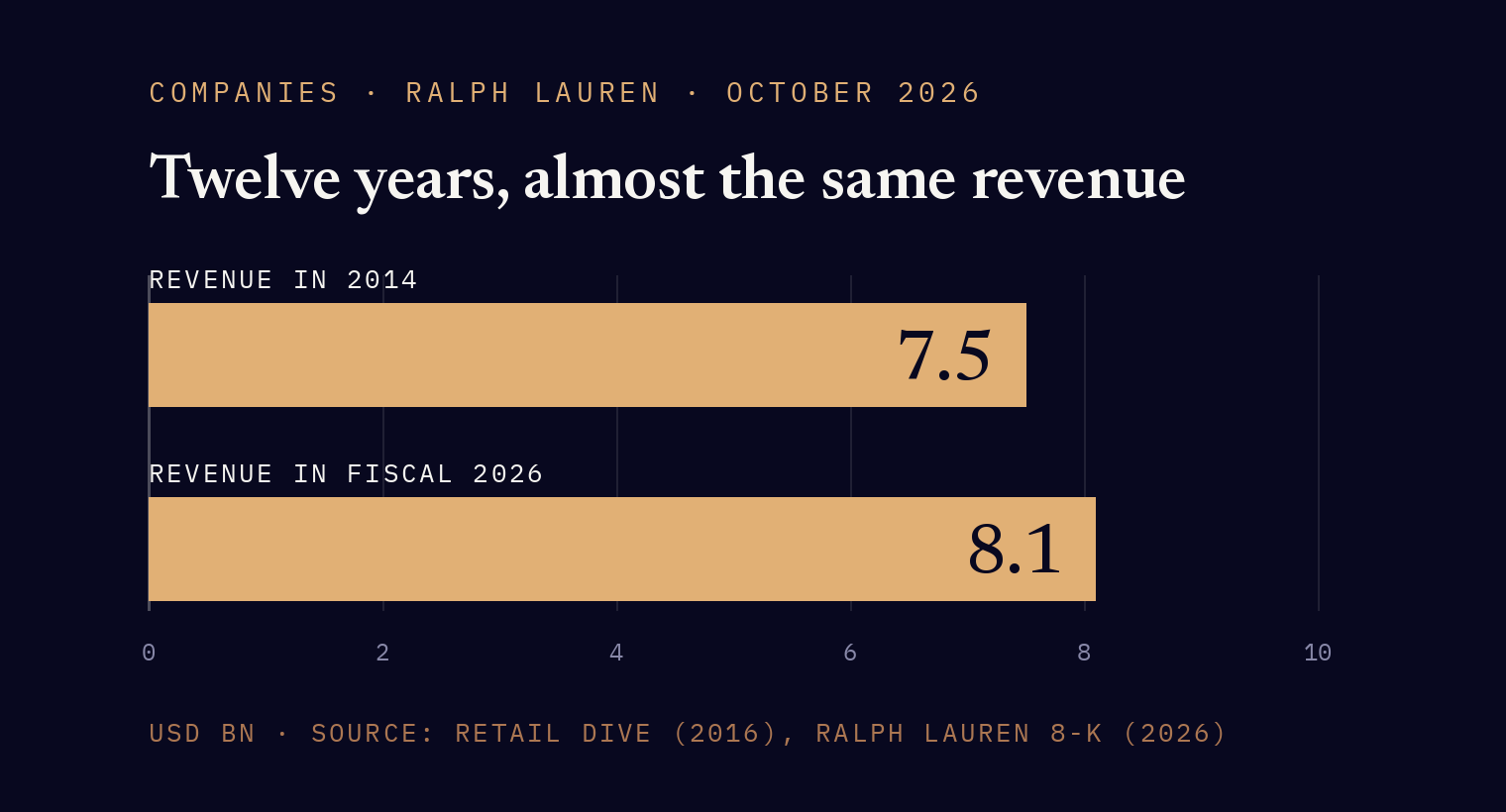
One number is worth thinking about, though. In 2014 Ralph Lauren had revenue of $7.5 billion. Today it is $8.1 billion. Over twelve years, revenue has grown by only about 8%. The whole story today is about margin and mix, not volume. (My own calculation.)
The catch: price instead of units
In the North American business, the quarterly report contains a detail worth a closer look. Comparable sales in the company’s own stores rose 9%. But the average price per item rose in the “high teens”, roughly 17–19%, and store traffic also went up. That means the average customer who comes into a store leaves with 7–8% fewer items than a year ago. (My own calculation.)
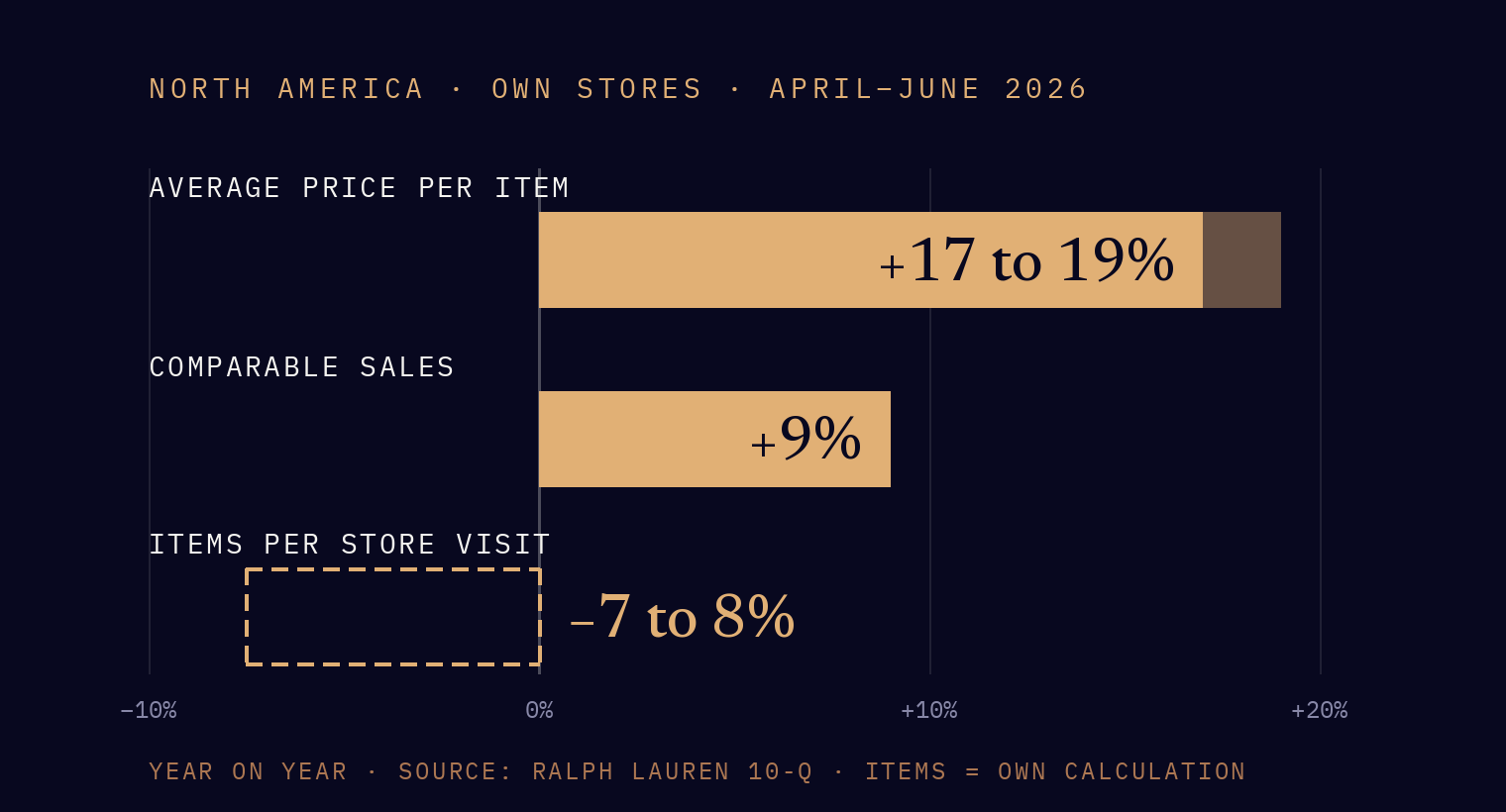
For now this is fine, because the higher price more than makes up for the lower volume. But this kind of mechanism works until it stops working. In Europe, sales in physical stores are already flat and traffic is falling.
Two more points about the quality of the numbers. North American sales to department stores rose 22%, but about 15 percentage points of that came from shipment timing and from restarting deliveries to one luxury retailer. In Europe, timing added about 5 points. Management itself says the second half of the year will be weaker: it will deliberately cut off-price sales and close weaker doors, China will compare against a very strong prior year, and tariffs are expected to rise in the second half. On top of that, fiscal 2027 has 53 weeks, so the following year will compare against a year that is one week longer.
Margin and multiple at a peak at the same time
Now the important part. The EBITDA margin over the last twelve months is 19.1%, against a five-year median of 15.7%. The stock trades at 18.4 times expected earnings for the next twelve months, against a five-year median of 15.6 times. Enterprise value to EBITDA is 12.9 times, against 10.0 times. (Koyfin, 7 October 2026.)
So the market does not only believe that the company has managed to raise prices. It also pays a premium multiple for the idea that this will last. Both numbers are above average at the same time. If the margin came back only partly (fiscal 2028 earnings 10% below today’s estimate) and the multiple returned to its median, the stock would be worth around $294, 18% lower. If both margin and multiple went fully back to their five-year averages, it would be around $219, 39% lower. (My own calculation.)
The argument against me: the price does not expect much
Here I need to be fair. I turned the calculation around to see what growth today’s price of around $359 assumes. With my discount rate of 10%, and assuming the stock trades at 17 times earnings in ten years, earnings per share only need to grow by about 7% a year. Analysts expect around 12% a year for the next three years, and in recent quarters the company has grown even faster. (My own calculation.)
So Ralph Lauren is not overpriced. If the company meets analyst estimates, my fair value comes out at around $400, about 11% above today’s price.
My model uses three methods (DCF, P/E and EV/EBITDA on fiscal 2028) and three scenarios. The result is my own calculation, not a price target:
| Scenario | Value per share | Versus price of $358.92 |
|---|---|---|
| Pessimistic | $254 | −29% |
| Base | $353 | −2% |
| Optimistic | $414 | +15% |
The base case is practically at today’s price. The problem is the asymmetry: the pessimistic case loses almost twice as much as the optimistic case gains. If I weight the scenarios 20/60/20, the expected return is around −4%, plus a dividend of 1.1% a year. (My own calculation.)
So why am I not buying?
Not because it is a bad company. It has a strong brand, a clean balance sheet and a management team that has done what it promised in recent years. I am not buying because at today’s price I get no cushion in case I am wrong, and the risk is skewed to the downside. Margin and multiple are both at a peak, and in this company’s history both have already gone back to average once.
It would start to interest me in one of two cases. Either the price falls far enough to roughly match my pessimistic scenario, or the company shows that its margin holds even in a weaker second half with higher tariffs. The second case would move my whole estimate up.
One more thing does not sit well with me. Over the last two years I could not find a single open-market purchase in the insider filings. CEO Patrice Louvet sold 47,000 shares for $16.6 million in February, roughly a third of the shares he held directly. Ralph Lauren himself has sold shares in late spring in each of the last two years, this year for $99.7 million. That is a small amount compared with his stake, though, and it follows a regular pattern. (SEC Form 4 filings and insider transaction trackers.)
What would convince me I am wrong
- Comparable sales in North America stop growing only through price, and the number of items sold stabilises.
- Adjusted gross margin holds year over year even in the third fiscal quarter (October to December), when the higher tariffs hit in full.
- China grows around 15% for the full year, as management promises, despite comparing against growth of more than 40%.
- The fiscal 2028 outlook confirms earnings of around $21 per share even without the 53rd week.
And the other way round: if comparable sales fall below 3% and the average price per item falls with them, it would mean that price increases have hit a ceiling.
Ralph Lauren reports its next results on 5 November.
Sources: 10-Q quarterly report for Q1 fiscal 2027 and earnings call transcript (6 August 2026), results press releases for fiscal years 2024–2026 and investor day materials (September 2025, SEC EDGAR), SEC Form 4 filings and insider transaction trackers (quantisnow, stockcircle), Koyfin (7 October 2026), Retail Dive (June 2016). My own calculations are marked in the text. The author does not own shares in Ralph Lauren.
The views expressed here are my own personal opinions and reflect my own portfolio decisions. This content is for informational and educational purposes only – it is not investment advice, a recommendation, or a solicitation to buy or sell any security. Always do your own research or consult a licensed financial advisor before making investment decisions.