Under one of the JD.com articles on Seeking Alpha, a reader recently left a comment that sums up how much of the market sees the company today. JD’s liquid assets are around $34bn, almost its whole market value. So, the reader argued, the stock should be worth at least a third more.
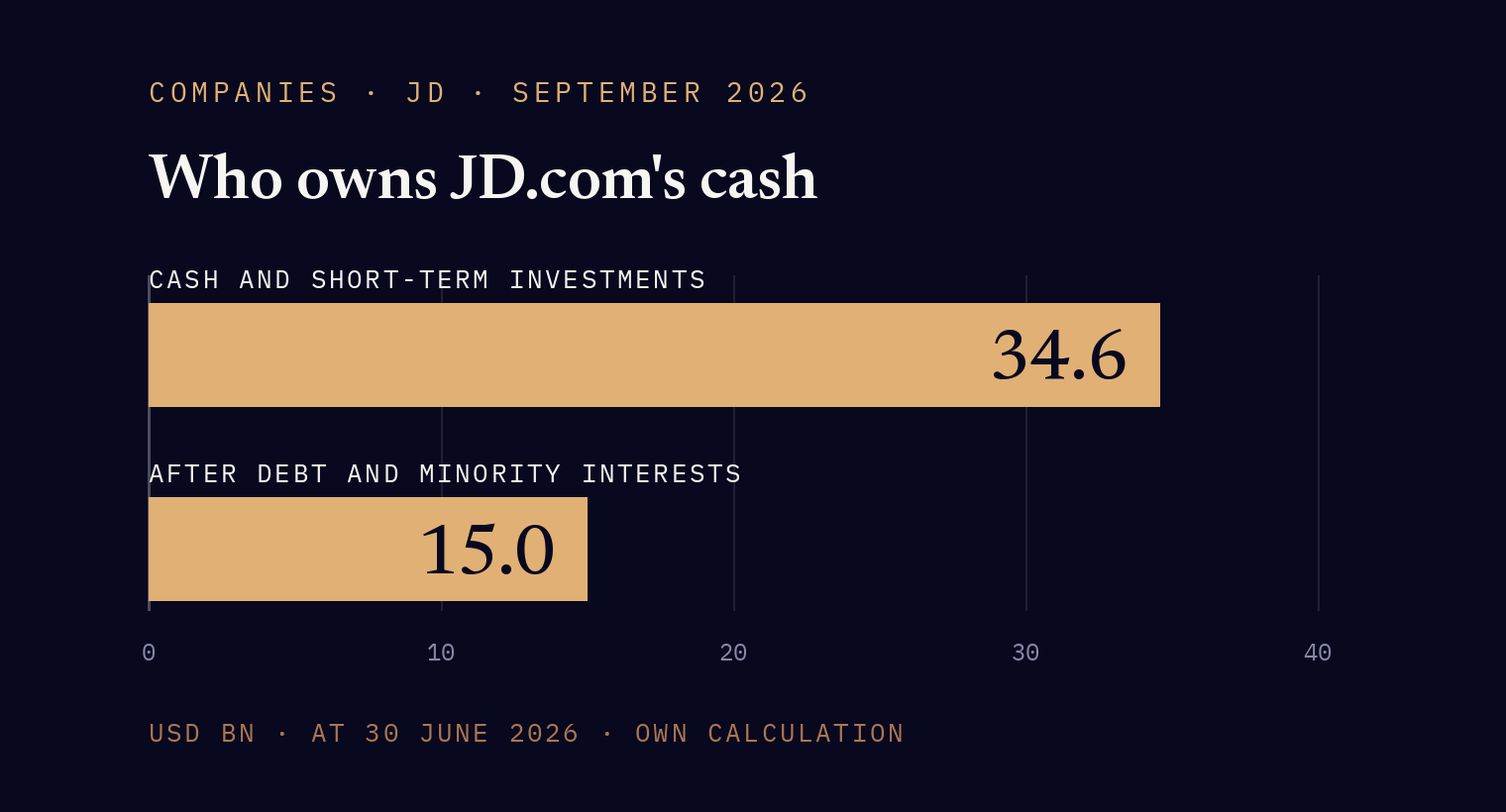
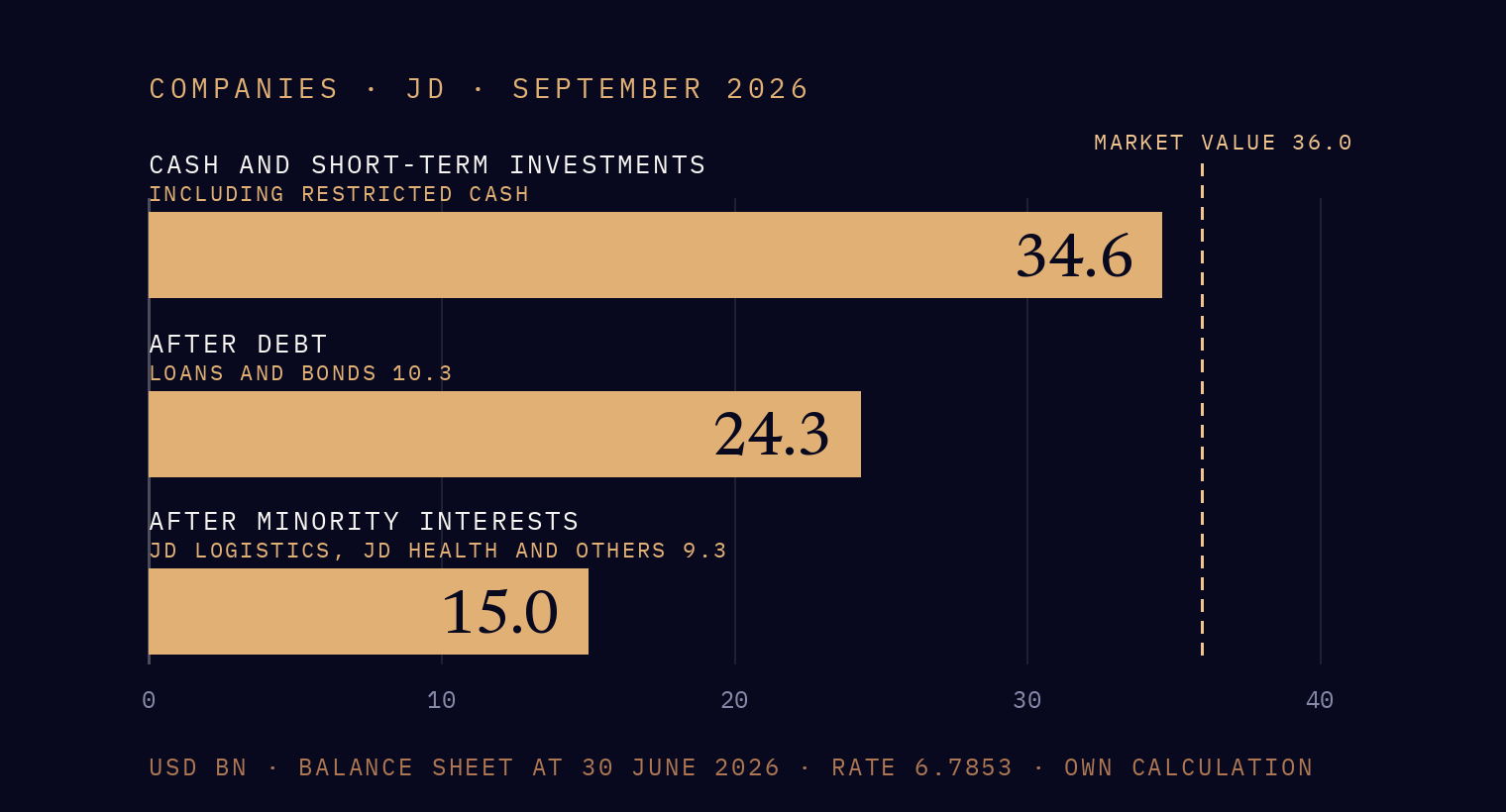
The number is right. At 30 June, JD held 235 billion yuan in cash, restricted cash and short-term investments, or $34.6bn. At $26.75 per share (ADS), the market value is about $36bn. Over the past year the stock has lost more than 20%.
But the comment skips a simple question: who does that money actually belong to?
The quarter: profit up, sales down
First, the second-quarter results. Revenue fell 2.9% to 346.4 billion yuan. Electronics and home appliances, almost half of revenue, fell 11.8%. Last year they were lifted by a government trade-in subsidy programme; this year they were not. Sales of other goods grew 5.6%.
Profit went the other way. Adjusted net income (non-GAAP, so excluding share-based pay and amortisation from acquisitions) rose 20.8% to 8.9 billion yuan. The gross margin of 17.1% is close to a record. The loss in New Businesses, which includes food delivery, more than halved year on year.
If you look at where the improvement came from, you find one main line: marketing spend fell by a quarter. Last year JD entered food delivery and fought Meituan and Alibaba for customers with subsidies. This year it cut back. So profit did not grow because the business grew, but because a price war ended. That is good news, but it works both ways. If competitors push again, JD will have to spend again.
Cash that also belongs to others
Back to the $34.6bn. First you have to take off debt, meaning loans and bonds of 69.9 billion yuan. That is $10.3bn, which leaves net cash of $24.3bn.
Then minority interests. JD Logistics and JD Health are separate companies listed in Hong Kong, and JD.com does not own all of them. Part of their cash and profit belongs to other shareholders. The balance sheet shows minority interests of 63.3 billion yuan, or $9.3bn at book value. Their market value is probably higher, so this is the milder version of the calculation.
That leaves about $15bn for JD.com shareholders, roughly 40% of the market value, not 100%. If you also count lease liabilities as debt, as Seeking Alpha does, the number is lower still. (My own calculation from the balance sheet at 30 June 2026, at 6.7853 yuan per dollar, the rate JD uses.)
That is not the whole story, because JD holds more than cash. It also owns stakes in other companies and securities worth 96 billion yuan, or $14.2bn at book value. A reader pointed this out in the discussion, and he was right: these are real assets that belong to JD. But stakes the company does not plan to sell, and unlisted investments, deserve a discount. If I take off about a third, they add around $9.5bn. JD.com shareholders are then left with more than $24bn, about two thirds of the market value. With leases counted as debt it is around $19bn, a little over half. (My own calculation.)
There is a catch. JD’s share of profit from these associated companies was about a quarter of its adjusted net income in the first half. If you value JD on a multiple of earnings, these investments are already in the price once, and you cannot add them a second time. The view “cash plus investments plus a cheap online shop” only works if you also remove their income from the earnings of the core business. Do that, though, and you find the market really pays very little for the retail business itself, and that is a stronger argument for the stock than the cash.
Most of the cash is suppliers’ money
More important than the size of the cash is where it comes from. JD is mostly a classic retailer: it buys goods into its own warehouses and sells them on. The customer pays immediately; the supplier gets paid after 64 days on average. In the meantime the money sits with JD.
At the end of June JD owed suppliers 229 billion yuan and held another 41 billion in customer advances. Net working capital (operating current assets minus operating current liabilities, excluding cash and debt) was negative, at −168 billion yuan. That is slightly more than all of the company’s net cash.
Put simply, almost all of JD’s cash is funded by suppliers and customers. It is not profit that has piled up over the years, waiting to be paid out.
That does not mean something is wrong. Costco and Walmart work the same way, and for a large retailer it is a normal, stable state. But it is asymmetric. When sales grow, this float (suppliers’ money the company holds in the meantime) grows with them and cash builds up by itself. When sales fall, the float shrinks and cash flows out without the company spending anything. 2025 showed it: free cash flow fell from 43.7 to 6.5 billion yuan, mainly because of working capital moves around the subsidy programme.
That is why I do not treat JD’s cash as a floor under the share price. It is a floor only until sales start to fall meaningfully.
The case against me: the company is paying the money out
To be fair, the strongest argument against what I just wrote is the buybacks. According to the company, JD has returned about $13bn to shareholders since 2023 and cut its share count by about 17%. In the first half of 2026 alone it bought back $1bn of stock, or 2.5% of shares outstanding.
So in practice the cash can be distributed. My argument only starts to apply when sales fall sharply and for a long time, and that is not happening. This year’s 2.9% decline came from a high base last year, not from customers leaving.
The open question is what comes next. Of the three-year $5bn buyback programme, only $1bn was left at the end of June, and the programme runs to August 2027. When a Goldman Sachs analyst asked on the earnings call whether the company would set a fixed share of profit to return to shareholders, he did not get a concrete answer. For me, a new buyback programme would be a more important signal than another quarter of profit growth.
Valuation: cheap, but not as cheap as the screens show
Koyfin shows a forward P/E of 6.6x. That is the multiple of earnings expected over the next twelve months, and it assumes the recovery continues. On reported adjusted earnings for the last twelve months ($2.43 per ADS), the P/E is 11.0x. Both are low, but the gap between them is exactly the recovery that still has to happen.
I build my model on three methods (DCF, P/E and EV/EBITDA on 2027) and three scenarios, with a 12% discount rate. According to Damodaran, China’s country risk premium is only 0.91 percentage points. I add one to two points myself for the VIE structure (a foreign holding company controls the Chinese business through contracts, not ownership), the US listing and geopolitics.
In the EV/EBITDA method I add net cash and long-term investments with a one-third discount, because EBITDA does not include their income. In P/E and DCF I do not add them, because their income is already in earnings.
The result is my own calculation, not a price target:
| Scenario | Value per ADS |
|---|---|
| Pessimistic | $32.1 |
| Base | $41.7 |
| Optimistic | $51.4 |
The range is about ±23% around the base case. In my view, though, the pessimistic case is too mild, because even there 2027 profit grows by almost half compared with the last twelve months. A really bad outcome looks different: competitors restart subsidies, profit stays at today’s level of around 23 billion yuan and the market pays six to seven times earnings for it. That gives $15 to $18 per ADS, 35% to 45% below the end-of-September price. (My own calculation.)
The end-of-September price of $26.75 is below the model’s pessimistic case but well above the stress case. So the market already allows for the recovery not lasting, just not for the worst. And the cash will not protect against the worst, because the cash itself depends on sales.
What would tell me I’m wrong
I follow a rule of writing down in advance what would prove my reading wrong. For JD.com there are five things:
- JD Retail does not return to positive revenue growth even in the fourth quarter of 2026.
- The loss in New Businesses, mainly food delivery, stops shrinking year on year for two quarters in a row.
- JD Retail’s operating margin falls below 4% in a quarter without major shopping festivals.
- The time JD takes to pay its suppliers falls below 55 days. That would mean suppliers are tightening terms and the float is starting to shrink.
- No new buyback programme by the end of 2027.
JD reports next on 12 November. The first item on this list will show by March at the latest.
Sources: JD.com’s Q2 2026 earnings release and earnings call transcript (13 August 2026), investor presentation (August 2026), Seeking Alpha and Koyfin (24 September 2026), Damodaran country risk premiums (January 2026). My own calculations are labelled in the text. The author holds a position in JD.com.
The views expressed here are my own personal opinions and reflect my own portfolio decisions. This content is for informational and educational purposes only – it is not investment advice, a recommendation, or a solicitation to buy or sell any security. Always do your own research or consult a licensed financial advisor before making investment decisions.