BioMarin’s second quarter sent the stock up sixteen percent in three trading days. Revenue rose a fifth to $990 million, earnings beat expectations by a wide margin, and the company raised full-year guidance. On the face of it, a clean quarter.
The more interesting question is the one the headline doesn’t ask: which part of the guidance went up?
The number that didn’t move
BioMarin raised the midpoint of its total revenue range by $25 million. It also raised the midpoint for VOXZOGO — its achondroplasia drug — by exactly $25 million.
The metabolic conditions segment was left unchanged.
That would be unremarkable if this segment weren’t the home of both of this year’s acquisitions. BioMarin bought Amicus in April, and with it Galafold and Pombiliti + Opfolda. The slide presenting them is titled “Acceleration Underway.” The company attached peak revenue targets of $1.4 billion and $1.2 billion and a decade-long plan.
Yet the outlook for the segment those drugs sit in is the same as it was in May — even though they will contribute two full quarters in the second half instead of two months.
There are two readings. Either management is being cautious and keeping room. Or the acquisition is tracking exactly to plan and has produced no upside surprise. Neither is bad news. But neither matches the word “acceleration,” and it is worth knowing that the entire guidance raise rests on a single product — the one that faced its first competitor this year.
What the second half has to deliver
Split the guidance into what is already banked and what still has to arrive, and the back half of the year looks tight.
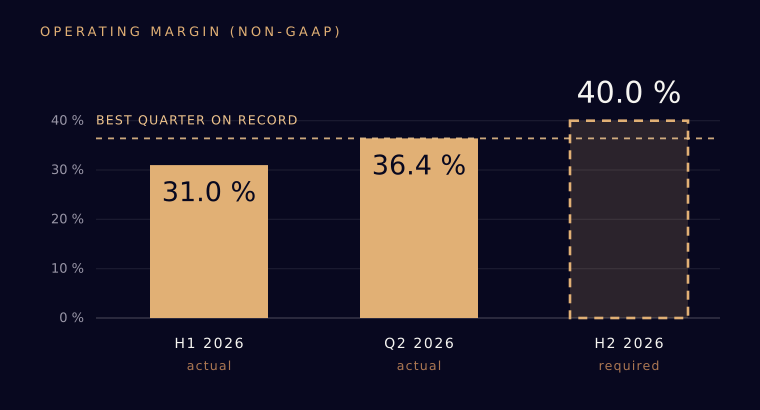
The first half produced roughly $1.76 billion in revenue and $385 million of operating income on the company’s own adjusted basis. For the midpoint of full-year guidance to hold, the second half has to deliver about $2.14 billion — twenty-two percent more than the first half — while growing profit by roughly sixty percent.
That implies an operating margin near forty percent. The second quarter came in at 36.4 percent; the first half as a whole at 31 percent. (Those last two paragraphs are my arithmetic from company guidance, not a reported figure.)
For full-year guidance to hold, the second half has to deliver an operating margin roughly four points above the best quarter the company has ever posted. Source: my calculation from company guidance as of 6 August 2026.
It isn’t impossible. Management says the acquisition savings land mainly in the fourth quarter, and the fourth quarter is seasonally the strongest. More than seventy percent of those savings sit in general and administrative costs — historically the category that actually gets delivered, unlike “revenue synergies,” which are mostly wishful thinking.
But it is a commitment, not a result. And the fourth quarter would have to be the largest in the company’s history.
Growth that measures a recovery
The headline slide shows earnings per share up fifty-nine percent. In small print beneath the same slide, the company notes that last year’s base included a write-off of acquired research from the Inozyme deal and an inventory write-down on ROCTAVIAN, a drug it pulled from the market.
So fifty-nine percent largely does not measure operating performance. It measures how far the company climbed off a base it depressed itself with one-time charges. I’d put the underlying growth closer to twenty-five or thirty percent — still a good number, just a different one.
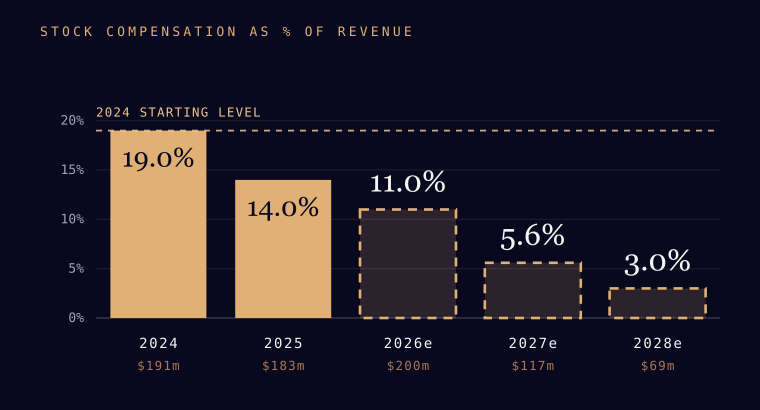
A similar asymmetry appears elsewhere in the same deck. The company sized its acquisition savings at $280 million under US accounting standards and $220 million on its own adjusted basis. The $60 million difference is stock-based compensation. So when reporting savings, the company treats it as a real cost. When reporting profit, it excludes it.
None of this is improper or unusual — the whole sector does it. But it is worth knowing that the gap between accounting profit and company-adjusted profit at BioMarin is currently fivefold: $0.23 per share against $1.20.
A competitive test that can’t be graded for a year
In February, VOXZOGO faced a US competitor for the first time. Over five months, the company says about ten percent of American patients switched — fewer than a hundred people. Ninety percent stayed.
Management presents this as proof of a defended position, and it has arguments: a five-year evidence base, exclusive approval for children under two, and the support wrapped around each patient. The reason for switching, the company says, isn’t efficacy but fatigue with daily injections.
But ten percent over five months isn’t a departure from the usual pattern — it is the usual pattern. When an established drug meets its first competitor, erosion typically runs ten to twenty percent of share per year for three or four years. Ninety percent retention after five months is the expected point on that curve, not evidence the curve doesn’t apply.
The answer arrives in three or four quarters at the earliest. Until then, any claim about a “defended position” — mine or the company’s — is premature.
Cheap against what?
BioMarin trades at roughly fourteen times this year’s expected adjusted earnings. Its historical median sits somewhere near fifty. That looks like an enormous discount.
It isn’t. That median comes from years when the company was barely profitable — and when the denominator is close to zero, any multiple comes out astronomical. Comparing today’s fourteen against a historical fifty is like comparing a temperature against one taken with a broken thermometer.
A simpler comparison is more useful: fourteen times earnings and about twelve times operating profit before depreciation are roughly what the market is paying for this company right now. Not a premium, but not a discount either. Anyone buying today isn’t betting the market will re-rate the stock upward. They’re betting the numbers show up.
Which is the whole thesis in one sentence: there is very little left in the price for this year, and something real for next year — provided the second half delivers the margin the guidance implies.
Three things I’d watch
Before closing an analysis, I write down what specifically would change my mind — and I write it now, not once I know the answer. Without it, any conclusion can be bent after the fact to look right. For BioMarin it comes down to three numbers and three dates.
If the operating margin in the third quarter, which the company reports on 27 October, clears 36.5 percent and the fourth quarter follows through, the tight guidance was realistic and my caution was misplaced.
If the number of children treated with VOXZOGO is still growing at a double-digit rate a year from now despite the competitor, the evidence base is a stronger defence than the base rate assumes.
And if the acquisition savings are at least half realised during 2027, as management promised, that would be the best news of all — because large debt-funded acquisitions historically don’t come apart in the first quarter. They come apart somewhere between the twelfth and the eighteenth.
Amicus closed at the end of April. That window opens next spring. One good quarter is not evidence the base rate doesn’t apply — it is exactly what the typical case looks like in quarter one.
Disclosure: I hold a position in BioMarin. Figures in this article come from the company’s earnings presentation and conference call transcript of 6 August 2026; calculations derived from guidance are labelled as my own estimates.
The views expressed here are my own personal opinions and reflect my own portfolio decisions. This content is for informational and educational purposes only — it is not investment advice, a recommendation, or a solicitation to buy or sell any security. Always do your own research or consult a licensed financial advisor before making investment decisions.