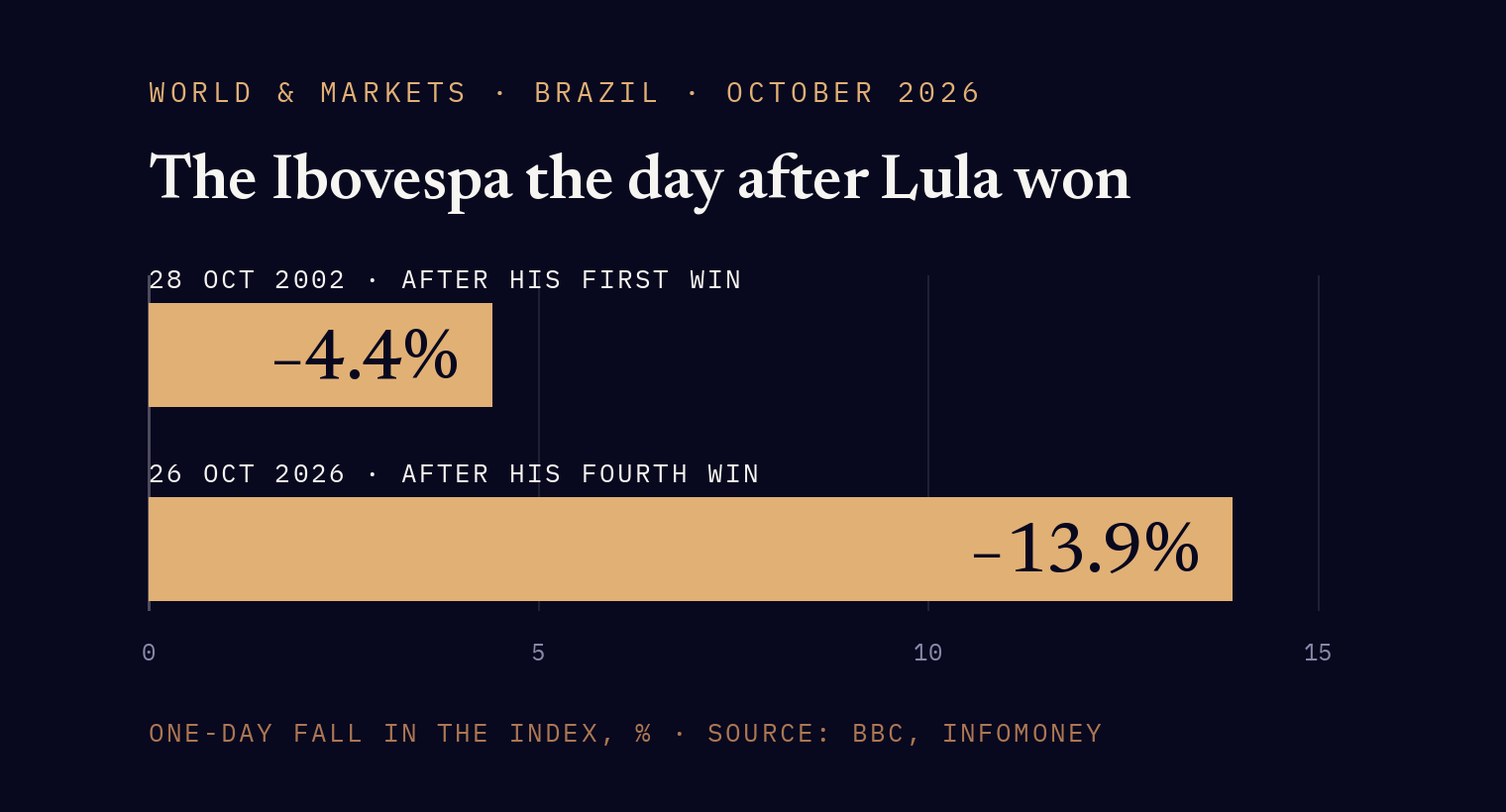
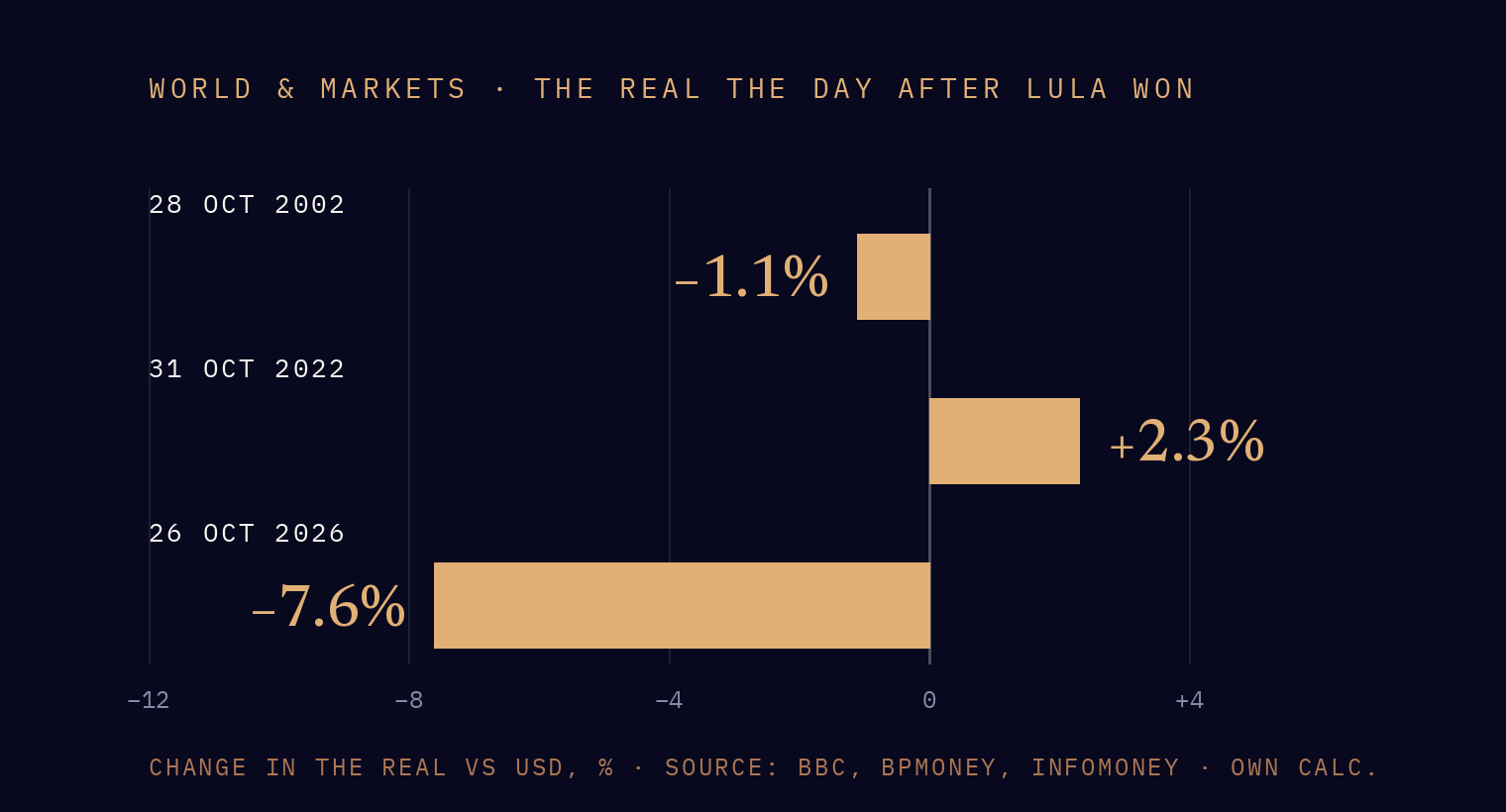
On Monday 26 October, the Brazilian stock market fell 13.9%. The Ibovespa, the main index of the São Paulo stock exchange, lost more than 28,000 points in a single day, and at 9:57 local time trading was halted for half an hour. It was the first circuit breaker since March 2020. The dollar rose 8.2% against the real to 5.40 reais, and the yield on interest-rate futures due in January 2029 jumped 2.7 percentage points to 15.25%.
Banks and companies that depend on the domestic consumer fell hardest. Banco do Brasil lost 29%, Bradesco 22%, Itaú 14%. Exporters that earn in dollars went the other way: Suzano rose 10%, Embraer 9%.
The trigger was Sunday’s election. Luiz Inácio Lula da Silva beat Flávio Bolsonaro by 51.79% to 48.21% and won a fourth term. The market had bet on the opposite. Since the first round, the Ibovespa had gained 7% and the real 5%. Investors were counting on Bolsonaro and the spending cuts he promised. Bolsonaro has refused to accept the result and wants to challenge it, although sources quoted by Reuters see little chance of success.
Lula and a market panic. Brazil has been here before.
2002: the panic came early
In 2002, Lula was running for the first time, and markets were afraid of him. People talked about “Lula risk”. Over the year the real weakened from 2.30 to a record 3.95 per dollar, losing 42% of its value. (Own calculation.) The premium investors demanded on Brazilian government bonds over US Treasuries rose above 2,400 basis points. In August, Brazil had to borrow $30 billion from the International Monetary Fund, and by the end of the year net foreign reserves excluding IMF money had fallen to $16 billion. Inflation climbed to 12%.
The core problem was debt. Roughly 40% of domestic public debt was linked to the dollar and almost half to the policy rate. Every drop in the real automatically made the debt bigger, and every rate hike made it more expensive to service. The market feared the country would stop paying.
The timing matters. The inflation-adjusted record for the dollar against the real came on 22 October 2002, five days before the vote. By the time Lula won, the worst was already in the price. On the first day after the vote the Ibovespa fell 4.4%, but the real weakened by only about 1%.
What turned the market
It wasn’t the vote that turned it, but what Lula did before and after it.
In June 2002 he published the so-called Letter to the Brazilian People (Carta ao Povo Brasileiro). In it, he promised to honour the country’s contracts and obligations and to manage a “negotiated transition” rather than act unilaterally. Once in office, he kept his word. His government set a primary surplus target of 4.25% of GDP, the budget surplus before interest payments. The central bank meanwhile raised the policy rate from 18% in June 2002 to 25.5% in January 2003.
The market reacted quickly. Writing in May 2003, economist Márcio Garcia called the first four months of Lula’s government “a very pleasant surprise” for financial markets. Capital came back and the real strengthened. By April 2003, Brazil was selling bonds at a spread of 783 basis points, and by October the spread was down to 603. Over Lula’s first term, from October 2002 to September 2006, the Ibovespa returned 323% including dividends.
To be fair, Lula also had help from the rest of the world. At the same time, China set off a commodity supercycle, and Brazil, as an exporter of iron ore, soybeans and oil, was one of its biggest winners. Much of the 2003–2010 boom cannot be credited to domestic policy alone.
2022: a control sample
When Lula won for the third time in October 2022, the market fell in the morning. The Ibovespa was down more than 2% and Petrobras more than 7%. By the close, though, the index was up 1.3% and the real had gained 2.3%. The result was no surprise back then: the race was close and Lula led in the polls. The market gave him the benefit of the doubt.
Nothing like that happened on Monday. The difference is that this time the market was not ready for a Lula win.
What is different today
| 2002 | 2026 | |
|---|---|---|
| When the panic came | months before the vote | the day after the vote |
| Ibovespa on the first day after the vote | −4.4% | −13.9% |
| Real on the first day after the vote | −1.1% | −7.6% |
| Foreign reserves excluding IMF loans | $16bn | $358bn (2025) |
| Net public debt | 56–63% of GDP | 72% of GDP (IMF estimate for 2026) |
| Inflation | 12% | 5.6% (IMF estimate for end-2026) |
| Signal to the market | the Letter + strict fiscal policy | no finance minister named yet |
(Changes in the real are my own calculation from exchange rates. Brazil owes nothing to the IMF today; it repaid its loans early.)
Brazil today is not as vulnerable as it was in 2002. Its reserves are more than an order of magnitude larger, and the IMF expects total external debt to fall to 31.5% of GDP. A weaker real therefore cannot push the country towards default the way it threatened to back then.
The weak spot is elsewhere: the domestic budget. According to the IMF, gross public debt is 97.8% of GDP this year and is set to reach 105% by 2031. It is refinanced at rates of around 14–15%. Monday’s jump in rates therefore worsens the budget on its own, and the budget is now the biggest question.
What is missing is the one thing that turned the market in 2002: a clear signal. Finance minister Dario Durigan said on Monday that the government would change the law, or the constitution if needed, before the end of the year to aim for the centre of its fiscal target. Whether he stays in the job is not certain. Lula has not chosen a successor yet.
What I take from it
I hold both Nubank and MercadoLibre, so this is not an academic question for me. On Monday I didn’t sell either position, and I added to Nubank after the fall. But I am not doing it on the basis that “it worked in 2002”.
The 2003 recovery didn’t come from Lula’s victory, but from two things that followed it: a credible economic team with a concrete number, and a tailwind from the rest of the world. The first is missing so far, the second is uncertain. History may repeat itself, but you can’t count on it.
I will watch two things. Who will run the finance ministry, and what budget for 2027 the government puts forward. And whether higher rates and a weaker real show up in credit quality at consumer lenders. MercadoLibre and Nubank both report in November. That will show whether Monday was a panic or the start of a more expensive Brazil.
Sources: InfoMoney (26 October 2026), Exame (26 October 2026), Investing.com and IBTimes (26 October 2026), John Williamson, Lula’s Brazil, PIIE Working Paper 03-1 (2003), Márcio Garcia, SIEPR Policy Brief (May 2003), InvestNews (2002 dollar record), Agência Brasil (8 October 2003), Congresso em Foco (Letter to the Brazilian People), InfoMoney (Ibovespa over Lula’s terms, 23 November 2022), The Brazilian Report and BPMoney (31 October 2022), BBC (28 October 2002), IMF, Brazil Article IV (23 July 2026). Own calculations are marked in the text. The author is a shareholder of Nu Holdings and MercadoLibre.
The views expressed here are my own personal opinions and reflect my own portfolio decisions. This content is for informational and educational purposes only – it is not investment advice, a recommendation, or a solicitation to buy or sell any security. Always do your own research or consult a licensed financial advisor before making investment decisions.