CBRE Group’s share price is down by a quarter over the past year. Yet last week the company reported results above analysts’ expectations, its earnings per share are up 41% over nine months, and the market pays about 14.5 times next-twelve-months earnings for it. The ten-year median is 16.5 times. At first glance it looks like a textbook opportunity: a high-quality industry leader at a discount.
I built my own model for CBRE and went through two years of results and the transcript of the call with management. I didn’t buy the stock. I don’t think CBRE is a bad company. I just think the discount the market is offering today is not as big as it looks. Here is why.
What CBRE actually does
CBRE is the world’s largest commercial real estate services firm. It has four parts:
- Advisory – leasing offices and warehouses, selling buildings, arranging financing. This is the most profitable part, but also the one that depends most on how many deals get done in the market.
- Building operations – maintenance, operations and technical services for large companies, and increasingly for data centres. Multi-year contracts, stable revenue, thin margins.
- Project management – managing construction and refurbishment projects for clients.
- Real estate investments and development – CBRE builds and sells property on its own account and manages money for investors.
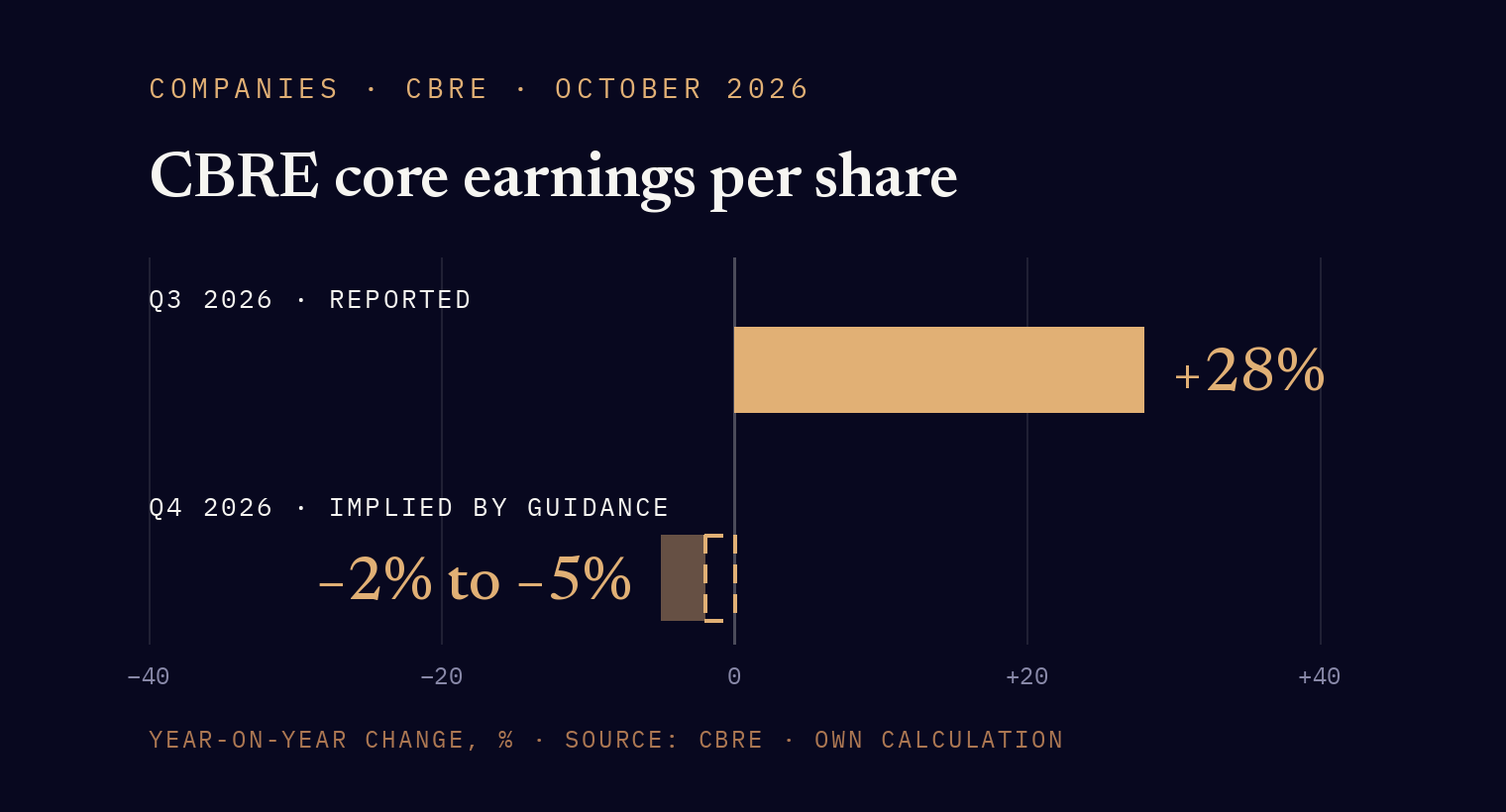
In the third quarter of 2026, revenue was $11.5 billion (+12.7%) and core earnings per share were $2.05 (+28%). Core means excluding amortisation from acquisitions and some one-off costs. That is how the company reports it and how analysts track it.
What I like
The fastest-growing part is data centre services. Their revenue rose 80% year on year, and management expects about $4.5 billion from them in 2027. Last week CBRE announced the purchase of Onnec, which builds and maintains data centre infrastructure in Europe and Asia.
The second thing is the shift from transactions to services. Building operations and project management now make up 77% of revenue. (Own calculation.) The balance sheet is healthy too – net debt is only 1.4 times annual operating profit – and buybacks really do reduce the share count. The company spent $1.2 billion on them in nine months.
Three things that hold me back
1. The guidance quietly assumes a weaker fourth quarter
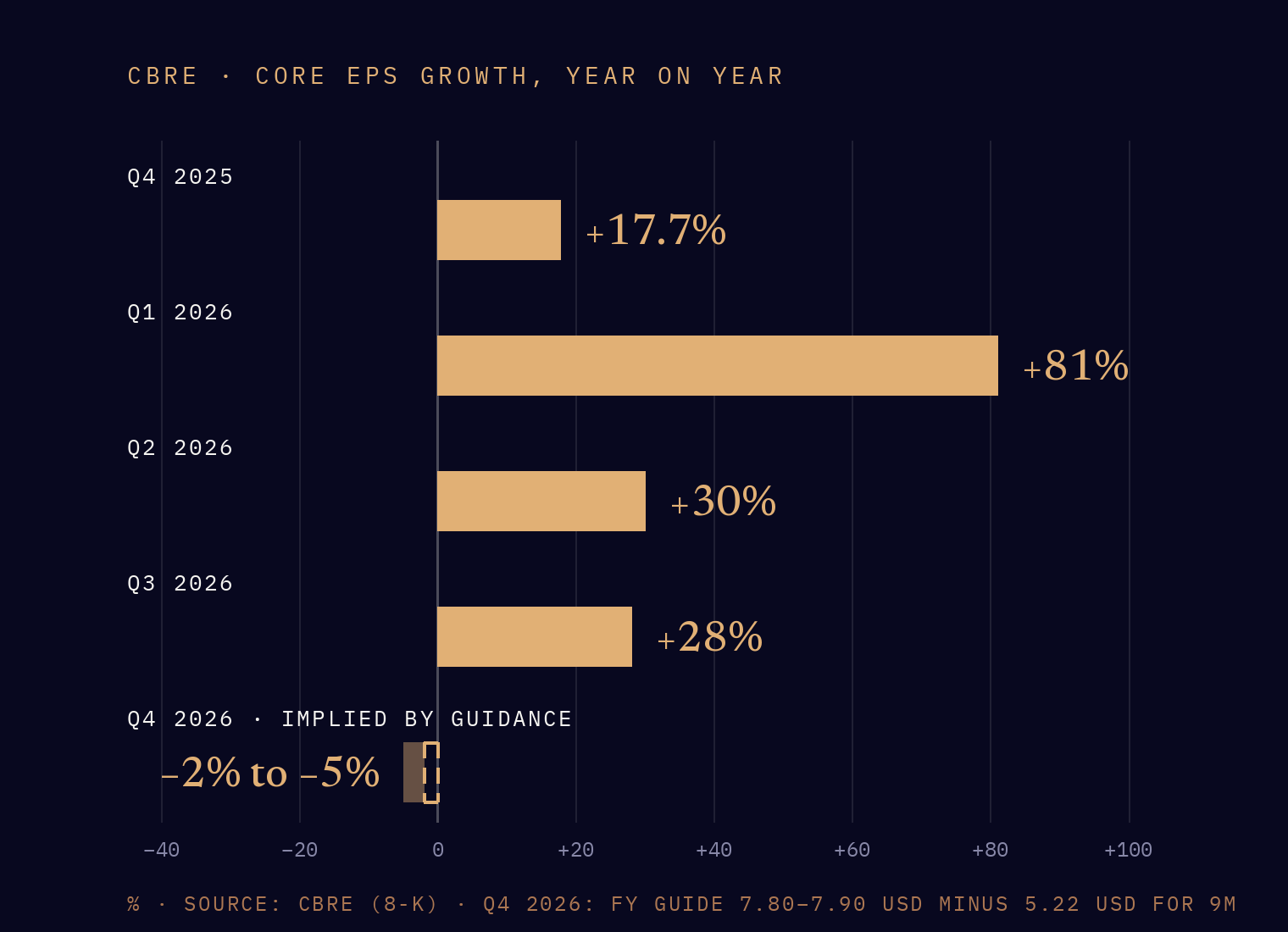
After the results, management confirmed its full-year 2026 core EPS guidance of $7.80–7.90. In the first three quarters the company has already earned $5.22. That leaves $2.58–2.68 for the fourth quarter, against $2.73 in the same period last year. So the guidance implies the fourth quarter will be 2–5% lower year on year. (Own calculation.) After three quarters of growth between 28% and 81%, it would be the first decline.
It is also clear where the beat came from. Operating income in the investments division jumped 127%, mainly thanks to data centre land sales. When a company beats estimates and doesn’t raise its full-year guidance, I read it as part of the profit simply moving earlier in the year.
2. Free cash flow includes property sales
CBRE calculates free cash flow differently from most companies. It adds in gains from selling real estate. Over the past twelve months it reported $1.83 billion, of which $894 million came from these gains. Without them, about $940 million is left, a yield of roughly 2.7% on today’s market value. (Own calculation.)
Sales of development projects are real money, but they are irregular. In all of 2024 they brought in only $142 million. The same land sales that drove this year’s profit are also holding up the cash flow.
3. 2023 showed how cyclical the company is
When interest rates rose sharply in 2023 and property deals froze, CBRE’s revenue still grew 3.6%. Core EPS, however, fell 32.5% and free cash flow dropped to $175 million. Stable services hold up revenue, not profit. Advisory is the most profitable part, and it loses the most in a downturn.
On the call, management itself said that property deals slowed in September and that it expects them to stay flat until mid-2027. For 2027 it talks about a “path to 15%” growth in EPS. That path, though, includes the Onnec acquisition and further planned deals, not only growth in the existing business. Part of the money for them is to come from cutting buybacks significantly.
What I think CBRE is worth
I combined three methods: ten years of discounted earnings, a valuation on an earnings multiple, and a valuation on an operating profit multiple that includes debt. My fair value comes out at around $143 per share. In the pessimistic scenario about $111, in the optimistic one $173.
| Scenario | What it assumes | Value per share |
|---|---|---|
| Pessimistic | lower 2027 earnings, 13× multiple | ~$111 |
| Base | 2027 earnings around $9, 16× multiple | ~$143 |
| Optimistic | faster growth, 18× multiple | ~$173 |
(Own model and calculations. A 16× multiple is roughly the ten-year median.)
Today’s price of around $122 is about 15% below my estimate. That sounds good, but the spread between the pessimistic and optimistic scenarios is ±20%. For a company whose earnings fell by a third in a single year, that is too little for my taste. The discount would need to be bigger to cover the worse outcome as well.
I also ran the calculation the other way round: what growth the market is pricing in. It comes out at roughly 4% a year for 2027–2030. (Own calculation.) So the market values CBRE as a company at the top of the cycle, not as a stable building manager. Management talks about 15%. The truth is probably somewhere in between, and until I know where, I don’t want to pay for it.
What would change my mind
CBRE stays on my watchlist, the list of companies I follow. The deciding date is 11 February 2027, when the company reports full-year results and its outlook for 2027. I am mainly interested in how much of the announced growth will be organic, meaning without acquisitions, and whether cash flow holds up in a year when the company sells fewer land plots.
If the outlook confirms solid growth without help from acquisitions, I will revise my cautious scenarios upwards. If not, I will wait for a price that offers a bigger cushion. A good company and a good investment are not the same thing. The difference between them is the price, and for a cyclical company, the timing as well.
Sources: CBRE Group, results for Q4 2025 to Q3 2026 (Form 8-K, SEC), Q3 2026 earnings call transcript (22 October 2026), CBRE Group, full-year 2023 results (BusinessWire, 15 February 2024), Koyfin and Seeking Alpha (data as of 27 October 2026). Own calculations are marked in the text. The author does not hold shares in CBRE Group.
The views expressed here are my own personal opinions and reflect my own portfolio decisions. This content is for informational and educational purposes only – it is not investment advice, a recommendation, or a solicitation to buy or sell any security. Always do your own research or consult a licensed financial advisor before making investment decisions.